
Gram’s Taralli: The Italian Snack I Grew Up With
RECIPES
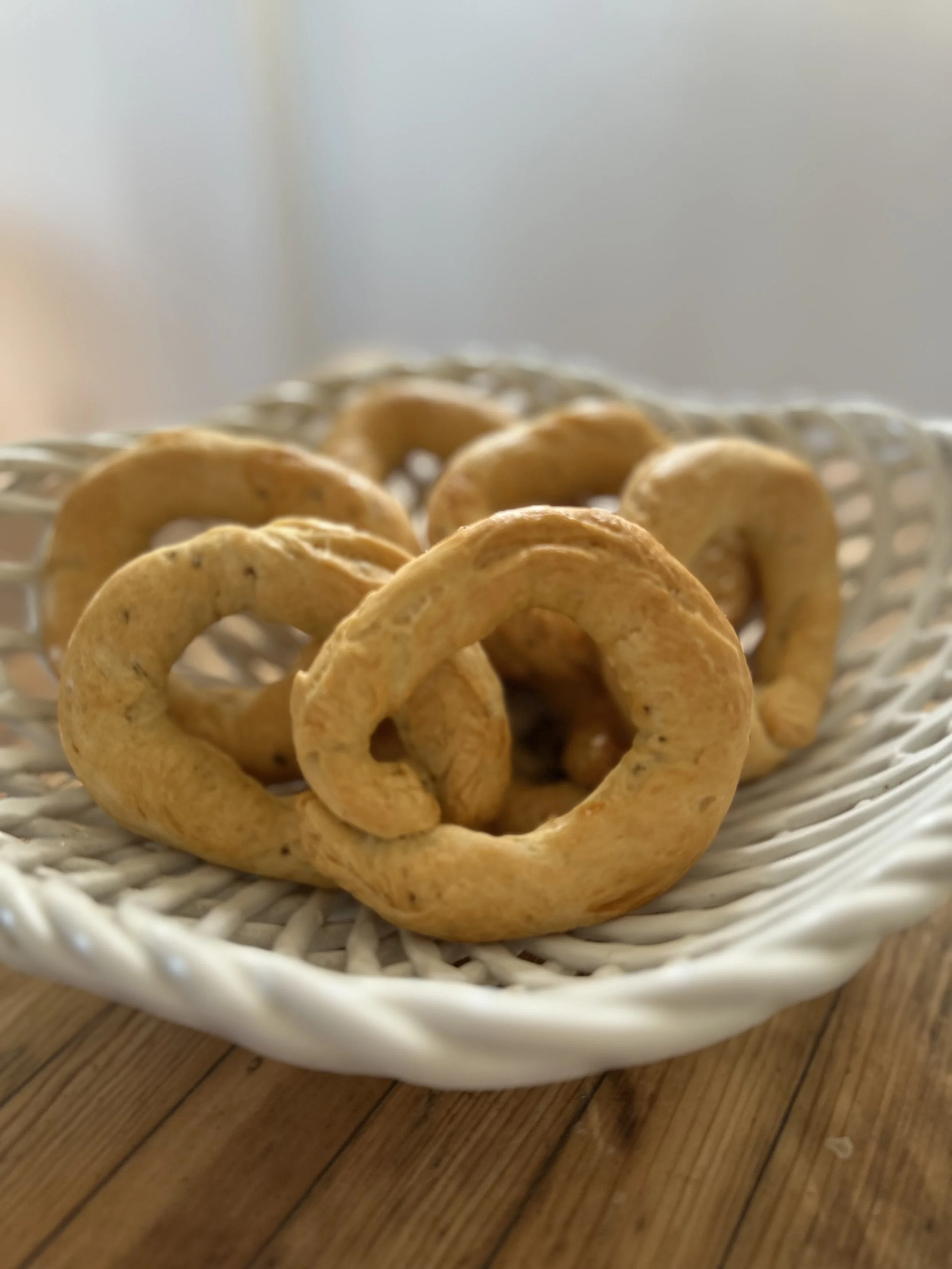
The Story Behind My Family’s Taralli
This weekend, I felt called to make my great-grandmother’s taralli.
Working from home, on my third cup of tea, I found myself craving something simple — something that tasted like childhood.
Growing up, there was always a bowl of these waiting on the kitchen table at Gram’s house… or Mimi’s. They were a pantry staple, always there and ready for whoever happened to come through the door.
We didn’t call them taralli. In our family, they were “tah-dolls.”
They were the first thing we reached for when we walked through the door. The quiet snack during afternoon tea. The crunchy companion to a glass of wine while everyone lingered around the table and talked.
And there was something about knowing that bowl would always be there that made the house feel like home.
Someone could stop by unexpectedly, and there was something to put on the table.
Someone could sit down for a cup of coffee, and there was something to reach for.
A conversation could stretch a little longer because there was always another “tah-doll.”
Taralli weren’t just a snack. They were part of the rhythm of being together.
A Taste of Southern Italy
Taralli are traditional ring-shaped, crunchy snacks from Southern Italy, particularly Puglia, Campania, and Calabria. They’re made from simple pantry staples — flour, oil, salt, wine, and water — and are often associated with cucina povera, the Italian tradition of making something delicious and satisfying from humble ingredients.
That simplicity is part of what I love about them.
There’s nothing fancy about flour, oil, salt and water. But somehow, when they come together, they become something people gather around.
And that has always been true in my family.
A Recipe Measured in Memory
Like many old family recipes, my great-grandmother’s taralli weren’t written down in precise measurements.
It’s “a little salt.”
It’s “two six-inch glasses of water.”
It’s a five-pound bag of flour poured straight into the pot.
It’s instinct.
It’s memory.
It’s knowing what the dough should feel like in your hands because you’ve made it enough times to stop measuring.
This recipe was passed down through generations of women who made it again and again — not from a cookbook, but from feel.
As I mixed and rolled the dough, I tried to channel my grandmother’s energy: trusting my hands, paying attention to the dough, and hoping I was getting it right.
I think that’s what makes family recipes so special. You aren’t simply recreating food.
You’re trying to recreate a moment.
And taralli have always been about moments for me.
They were waiting in the kitchen when family came over. They were something to put out for guests. They gave everyone something to nibble on while conversations started and stories unfolded.
When I was recently a guest on an Italian American podcast, I brought my family’s taralli with me.
I wanted people to taste them, of course. But I also knew they would do something else.
They would invite conversation.
And they did.
Food has a way of doing that. You put something familiar in the middle of a table, and suddenly people start telling stories.
Who made it for them.
What their grandmother called it.
What they ate growing up.
Where their family came from.
That’s what these little rings have always represented to me.
Not just food, but an invitation.
An invitation to come in, sit down, have a glass of wine, reach into the bowl and stay awhile.
For generations, my family’s taralli were made to be shared. They were always there when someone came through the door, waiting on the kitchen table for the next person to reach for one.
I still make them for the same reason.
Because some foods are more than recipes. They carry the feeling of a place, a family, and a way of gathering around the table.
Now I want to share that feeling beyond my own kitchen.
Want to Taste My Family’s Taralli?
I’ll be making my family’s taralli in small batches in Southern California very soon, using the same recipe and tradition that have been part of my family for generations.
I’m starting small — sharing them locally and bringing them to farmers markets — with the hope of one day seeing my family’s taralli on tables far beyond my own.
If you’re in Southern California and would like to be notified when they’re available, leave your name and email below.
Not in California?
You can still bring a little of my family’s tradition into your own kitchen.
Keep reading for my great-grandmother’s taralli recipe.
Gram’s Taralli
PREP TIME: 3 HOURS 30 MINUTES
COOKING TIME: 1 HOUR 45 MINUTES
MAKES: SIX DOZEN
Before you begin, one important note: this is a family recipe that was traditionally made without precise measurements. I’ve translated those old instructions into measurements that are easier to follow in a modern kitchen, but the spirit of the recipe remains the same — simple ingredients, your hands, and a little trust in the process.
Ingredients:
5 lbs all-purpose flour
2 tsp salt
2 tsp ground black pepper
90 g fennel seed
2 ¼ tsp instant yeast
2 ½ cups Mazola corn oil, divided
8 large eggs, divided
28 oz plus 1 tbsp lukewarm tap water, divided
Directions:
1.In a large, deep pot, add the flour, salt, pepper, fennel, and yeast. Mix together until evenly combined.
2.Make a well in the center of the flour mixture. Add 2 cups oil, 7 eggs, and 28 oz water directly into the well.
3.Using your hands, begin incorporating the wet ingredients into the flour. Continue mixing for about 7 minutes, until the dough comes together and is no longer sticky. It should feel medium-firm and smooth, and should not stick to your hands.
4.Remove the dough from the pot. Coat the bottom and sides of the pot with 2 tbsp of oil. Return the dough to the pot and knead until the oil is fully absorbed.
5.Cover the pot with plastic wrap and then a dish towel. Place in a draft-free area and allow the dough to rise for about 3 hours, or until doubled in size.
6.Preheat oven to 350 degrees.
7.Grease a baking sheet with 1 tbsp of oil.
8.Take a small fistful of dough and roll it into a rope about ¼ in thick and 10 in long. Form the rope into a circle and pinch the ends firmly together to seal. Place on the prepared baking sheet, spaced evenly. You should be able to fit 12 taralli on a standard-size baking sheet.
9.In a small bowl, beat 1 egg with 1 tbsp of water. Brush the tops of the taralli with the egg wash.
10.Bake for about 35-40 minutes, or until golden brown.
NOTES:
Keep the ropes thin. Don’t roll the dough too thick — about ¼ in is ideal. If they’re too thick, they won’t get that signature crisp texture and will taste too dry.
Don’t skip the anise. Even if you’re unsure about it, trust the recipe. The anise doesn’t overpower — it gives the taralli their flavor.
Watch the browning closely during baking. They should be a deep golden brown, not too pale and not too dark. If they’re getting too dark, remove them promptly. Every oven runs a little differently.
Rotate your pans while baking if making two sheets at once. Switch their positions halfway through baking to ensure even browning.
They keep beautifully stored in airtight bags or containers and will stay fresh for weeks. You can also freeze them to enjoy later — just thaw at room temperature when you’re ready for a taste of home.
Leave a bowl on the table waiting for company and serve with coffee, tea, or a glass of wine. That’s how they’re meant to be shared.
Love Taralli, But Not the Work?
I love making these because they connect me to my family, but I’ll be honest — they’re time-consuming!
There’s something special about making them yourself, but there’s also something pretty wonderful about opening a bag and having them ready to share.
That’s where I come in.
Made Them?
I’d love to see your taralli.
Leave me a comment below or tag me @christinaminutillo and let me know what you call them in your family — especially if your family had its own name for them, too.
Because that’s the thing about food traditions: they may start with one family, but they have a way of traveling.
From my great-grandmother’s kitchen, to Gram’s table, to my own kitchen, to an Italian American podcast, and now hopefully to your table, too.
Every tarallo carries a little bit of that story.
Love the stories behind the recipes?
Join my Substack for Letters From Christina—where I share the traditions, memories, and moments behind the food that connects us. [Subscribe]

Read All the Latest Articles

I drove 2,054 miles from Los Angeles to The Gorge in Washington for a bucket-list concert. Here’s what the five-day road trip was really like, from camping at The Gorge to discovering the unexpected beauty of Oregon along the way.